
Year 6 · Selective School and Opportunity Class
Year 6 Thinking skills practice for selective school tests
The Year 6 thinking skills questions are the ones families find hardest to prepare for, because there is nothing to revise. What improves is recognition — having met the shape of the argument before.
What the section covers
- Deduction
- Certain conclusions drawn from a small set of statements.
- Flawed arguments
- The unstated assumption, the leap that does not follow, the appeal that is not evidence.
- Puzzles with constraints
- Arrangements that satisfy several conditions at once.
- Evidence
- Which fact would settle the question, and which merely sounds relevant.
Sample questions
8 real questions from our Year 6 papers, covering the different ways this section asks things. Answer the ones you can click; the rest show how they work. Nothing to sign up for.
Question 1
Which one of the following diagrams cannot be the appearance of the unfolded sheet?
A rectangular sheet of paper is folded in half, and then folded in half again with the second fold at right angles to the first. A corner of the folded packet is cut off. The paper is then fully unfolded.
Question 2
Where did Ben finish? Four runners—Alex, Ben, Chloe, Dana—ran to the lake and back. - Nobody finished before Ben. - Exactly two people finished after Chloe. - Dana finished before Alex.
Question 3
Which statement best shows the mistake?
Mr Tran wants to test if listening to classical music during homework improves spelling. He splits the class by handedness: right-handed students listen to music; left-handed students work in silence. After a week, the music group scores higher. He concludes, “Classical music improves spelling.”
Question 4
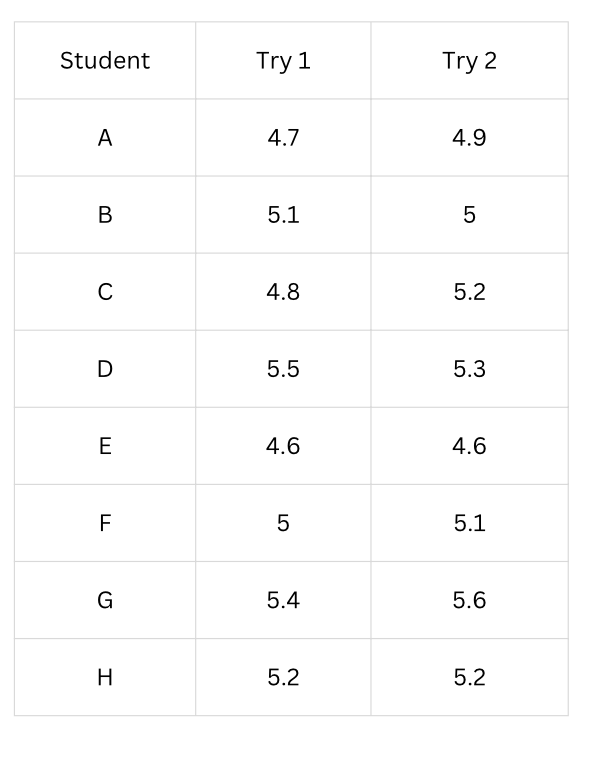
Who came 3rd?
In a long jump, each of 8 students gets two attempts; the longer counts.
Question 5
Which statement, if true, most weakens her argument?
Lena argues: “We should ban all fireworks because they always harm animals.”
Question 6
Whose reasoning is correct?
Two beetles look identical. The Ruby beetle eats only leaves; the Amber beetle eats many things but never leaves (leaves are toxic to Amber). Mai and Khanh rescue one beetle and want to know its species. Mai: “If we feed it berries only, we won’t know whether it’s Ruby or Amber.” Khanh: “The only way to know for sure is to give it leaves.”
Question 7
If the information above is true, whose reasoning is correct? Sam: “If we only feed it bread, we won’t be any closer to knowing whether it’s a Pearl or a Slate.” Riley: “The only way to know for sure would be to give it some fish.”
Two gull species look almost identical: the Pearl Gull and the Slate Gull. The only reliable difference is their diet. Pearl Gulls mainly eat fish and crabs, but they will occasionally eat bread or chips from tourists. Slate Gulls eat almost anything along the shore, but they never eat fish (raw fish makes them ill). A rescued gull is recovering at a wildlife centre. Sam and Riley want to figure out which species it is.
Question 8
Which statement must be correct? You arrive this morning and see the Science Teacher unlocking the lab. - The caretaker opens the lab every day except Saturday. On Saturdays, the lab either stays closed or is opened by the Science Teacher. - The Science Teacher is only in the lab for experiments (mornings) or science fairs (afternoons). - Mornings are reserved for experiments; afternoons for fairs. - The teacher always arrives 15 minutes early and never schedules experiments and fairs on the same day.
Keep going with the full papers
Ten Year 6 thinking skills papers, 360 questions.
Aussie Edu Hub is an independent educational practice platform and is not affiliated with ACARA or any state education authority. NAPLAN is a registered trademark of ACARA.